The world’s highest-altitude tower-type solar thermal power plant recently completed the installation of its heliostats, which were made by Dongfang Electric Corporation (DEC).
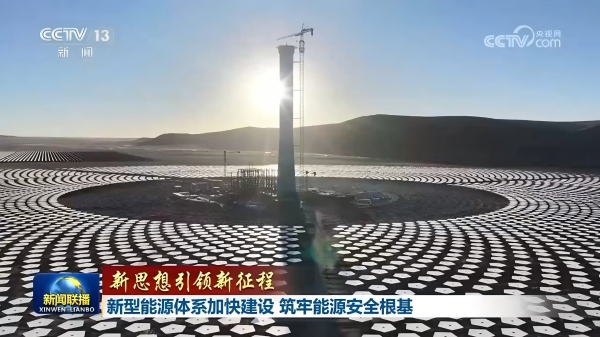
China Central Television reports on the world’s highest-altitude tower-type solar thermal power plant. [Photo/sasac.gov.cn]
The power plant, located in Amdo County of Xizang Autonomous Region, has a 100-megawatt installed capacity. It is the world’s first solar thermal power station built at an ultra-high altitude of 4,650 meters, under ultra-low temperatures and with an immature grid, and it is Xizang’s first tower-type solar thermal power station.
The heliostat field is composed of 15,927 mirrors. Each one occupies 50.23 square meters, thereby producing an area of about 0.8 million square meters that can effectively receive light.
DEC has effectively addressed the multiple challenges resulting from the power plant’s location on the roof of the world, such as fierce wind on the plateau, strong ultraviolet rays and ultra-low temperatures. The heliostat has a cutting-edge radial shape, which is supported by a light-weight, high-rigidity structure. Its precision to catch light is industry-leading, as it can turn with nearly zero backlash. Owing to its use of special materials and a coating that resists ultraviolet rays, the heliostat ensures excellent performance and durability.
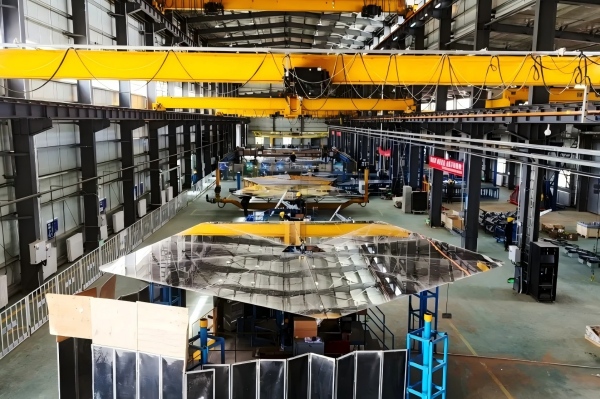
The world’s first digital and smart production line for heliostats that are suitable for operating at an ultra-high altitude. [Photo/sasac.gov.cn]
DEC has established the world’s first digital and smart production line for heliostats that are suitable for the conditions at an ultra-high altitude. The production line, fully automated, can produce 6,000 square meters of heliostats daily.
Upon operation, the power plant will be able to run about 2,551 hours annually, and can generate about 255 million kilowatt-hours of power annually. It is expected to save 60,000 tons of standard coal and reduce 165,000 tons of carbon dioxide emissions. The plant will be able to meet the needs of about 50,000 households in Amdo and neighboring regions, thereby alleviating the power supply pressure of Xizang’s power grid in the winter and injecting impetus into the development of clean energy in the region.
DEC is responsible for the design and supply of core devices for China’s landmark solar thermal power stations in Xizang, the provinces of Gansu and Qinghai as well as the Xinjiang Uygur Autonomous Region. These projects demonstrate DEC’s contributions to China’s utilization of solar thermal power and to the country’s establishment of a new energy structure.
(Executive editor: Zuo Shihan)