On November 21, 2015, LaoSat-1, Laos’s first communications satellite and China’s first satellite export to an ASEAN country — was successfully launched. Jointly developed by China Aerospace Science and Technology Corporation (CASC) in collaboration with Laos, it has since provided stable satellite services nationwide.
Expanding Access to Media
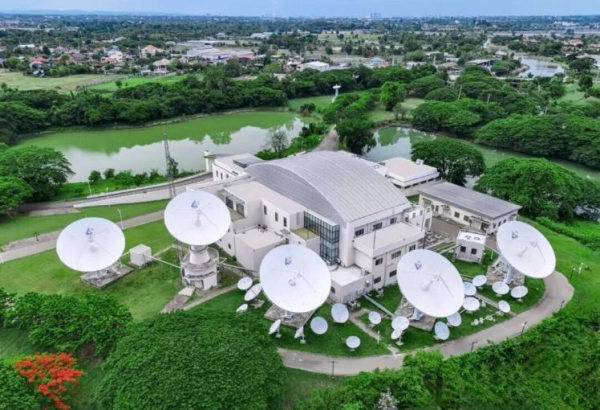
A view of the Lao Asia Pacific Satellite Co., Ltd. [Photo/sasac.gov.cn]
China’s “Eight Major Assistance Projects in Laos” is a program which includes providing digital TV to 100 rural communities. Leveraging its satellite TV system, Lao Asia Pacific Satellite Co., Ltd. (LaoSat) implemented Phases I and II of the digital TV project, installing complete satellite systems in 70 of Laos’s most remote villages.
Advancing a Digital Silk Road
LaoSat-1 is Laos’s first “university in space.” Since 2014, Lao technicians have trained intensively in China on satellite telemetry, control, payload management, and signal monitoring. Over eight months, they progressed from checking dictionaries for every term to independently performing routine operations.
Over the past decade, LaoSat has obtained eight categories of operation licenses, expanding into satellite communications, broadcasting, broadband access, and more. Its services now cover all of Laos and several Southeast Asian countries.
Fostering Cross-Border Cultural Exchange
In provinces near Vietnam and Cambodia, many villagers did not speak standard Lao. Satellite television introduced them to standard Lao for the first time. Today, more than 2,000 students are studying Chinese at the Confucius Institute of the National University of Laos. The world beyond the screen is inspiring more young people to pursue new opportunities.
As LaoSat-1 approaches the end of its design life in 2030, LaoSat is already exploring high-throughput satellites and low-Earth-orbit constellations to enhance this “digital sky road”, making it wider, smarter, and more resilient for the future.
(Executive editor: Yuan Ting)