Energy serves as a vital material foundation for economic and social development, but it is also a major source of carbon emissions. During the 14th Five-Year Plan (2021-25) period, China Datang Corporation Limited (China Datang) prioritized ecological conservation and low-carbon development, and forged ahead with green transformation with unprecedented speed and intensity. It contributed significantly to national energy security and reform, as well as the building of a beautiful China.
During the 14th Five-Year Plan period, China Datang witnessed its blueprints being turned into realities around China. By the end of November 2025, its installed capacity had reached 207.9 million kilowatts, including 50.48 percent of power generated from clean energy, an increase of 12.3 percentage points.
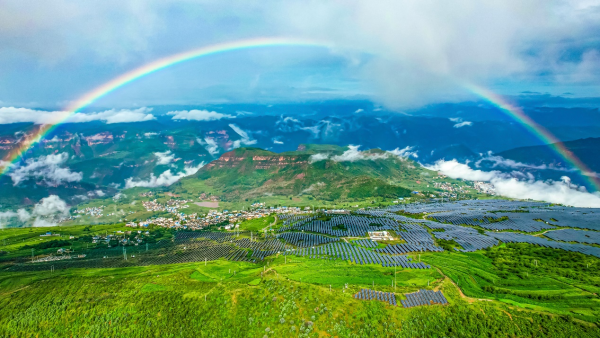
Photovoltaic panels on the grassland. [Photo/sasac.gov.cn]
Advancing toward Green Development
Leveraging China’s rich wind and solar resources, China Datang has intensified its efforts in new energy development, forming a development pattern that integrates large-scale onshore wind and solar bases, offshore wind power deployment, and the coordinated growth of both centralized and distributed projects. The construction of five 10-gigawatt-level bases and 20 gigawatt-level renewable energy bases was sped up. The country’s first group of six large new energy bases has been commissioned. The company's installed new energy capacity has surged by 133.4 percent compared to 2020.
On the mudflats of Xiangshan County in East China’s Zhejiang Province, the Changdatu Tidal Flat Photovoltaic (PV) Project, the country’s first large-scale PV power project located in an intertidal zone, is converting solar energy into clean power. Marine products like oysters and crabs are fostered under the panels. With a focus on ecological remediation targeting heavy metal pollution, rocky desertification and mining subsidence, China Datang has built the Loudi 1,000-megawatt PV project in the depleted tin mining area in Lengshuijiang County, Central China’s Hunan Province. Aside from power generation, the project supports growing plants under panels, raising livestock among panels and improving soil conditions to revive the resource-drained tin mine.
On the snowy plateau, where the average altitude is 5,050 meters, China Datang has built Basu Wind Farm in Changdu City, Southwest China’s Xizang Autonomous Region, in less than four months, setting a new record for wind farm construction at such a high altitude. At the Jinping West Wind Farm in Southwest China’s Yunnan Province, the country’s largest gigawatt-level plateau wind farm, a beautiful synergy unfolds. The colorfully painted turbines and the spectacular sea of clouds are painting a picturesque scene of positive interaction among agriculture, industry and tourism.
China Datang has successively commissioned offshore wind farms in Guangdong, Fujian and Liaoning provinces. Sixty turbines, each with a rotor diameter of 240 meters, now stand firm above the waves in the waters off Danzhou City, South China’s Hainan Province. This expansion has pushed the company’s offshore wind installed capacity beyond 2 million kilowatts.
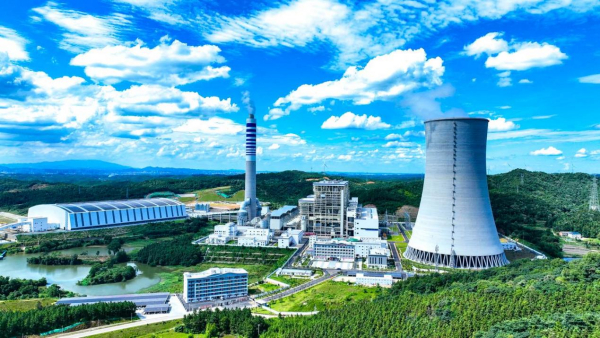
An upgraded thermal power plant. [Photo/sasac.gov.cn]
Striving for Clean and Efficient Power Generation
Given China’s resource profile of abundant coal but limited oil and gas, China Datang has balanced energy security with green transition. It has vigorously advanced the efficient, clean use of coal, using fossil energy as a foundational guarantee to support the low-carbon energy transition.
China Datang has refurbished outdated coal-fired generation units. It expanded the installed capacity of a thermal power plant in Zhuzhou City, Central China’s Hunan Province. Changchun No.2 Thermal Power Plant in Changchun, the capital of Jilin Province, was moved to the suburban areas. Meanwhile, the capacity replacement project of the Douhe Power Plant has revitalized the aging facility.
China Datang refined 101 generation units for greater operational flexibility. Datang Tuoketuo Power Plant is advancing heating retrofits and developing toward a heating capacity of 91 million square meters of area, while forging ahead with the second phase of a large-scale new energy base and speeding up the development of a gigawatt-level integrated energy base that combines wind, solar, thermal power, heating and energy storage.
China Datang has been actively building flexible coal-fired power plants to serve the considerable need in East and Southeast China, such as the power plant in Lyusi Port in East China’s Jiangsu Province. The second phase of the Xinyu Power Plant in East China’s Jiangxi Province, a clean and high-efficiency coal-fired plant, has established a smart management system that covers the entire lifecycle of its equipment. The ninth phase of the Baoding Thermal Power Plant in North China’s Hebei Province has achieved green, low-carbon and efficient operation by applying advanced technologies to two 350-megawatt steam turbines.
China Datang has emphasized industrial coordination to revitalize its coal-to-chemicals industry. Multiple coal-to-gas or coal-to-natural gas plants were put into operation, upgraded or expanded. These efforts collectively signify the successful establishment of a fully integrated coal-power-chemical industrial chain.
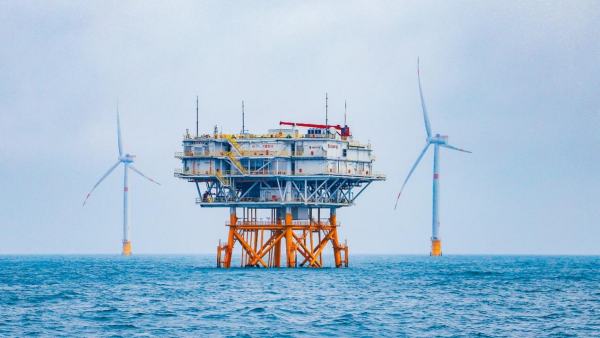
An offshore wind farm. [Photo/sasac.gov.cn]
Boosting High-Quality Industrial Development
China Datang is committed to innovation-driven development. It has spurred the development of emerging industries and spearheaded high-quality industrial development with demonstration projects.
China Datang has actively explored pilot and demonstration projects for energy storage with various technological pathways, with a total installed storage capacity of 3.14 gigawatts. China’s first 100-MWh sodium-ion energy-storage power plant in Hubei Province has overcome multiple challenges and achieved the world’s first large-scale commercial application of this technology.
In Zhongwei City, Northwest China’s Ningxia Hui Autonomous Region, the company has built the world's first 100 MW compressed air energy storage demonstration project featuring a fully artificial underground gas storage facility. This project has established a complete technological system adaptable to most geological conditions in China.
China Datang has explored green hydrogen production. It has launched pilot projects in Hebei Province and Inner Mongolia Autonomous Region, forming a relatively complete layout of the hydrogen energy industry chain. The 150,000-kilowatt wind-solar hydrogen production demonstration project in Duolun County, Inner Mongolia, has now entered market-based operation. It serves as a positive demonstration for large-scale hydrogen production through solar and wind energy, energy storage technological breakthroughs and clean hydrogen industrialization.
China Datang is making breakthroughs in core technologies. The Datang Zala Hydropower Station represents a significant endeavor in the high-quality development and high-level conservation of water resources on the plateau. The domestically produced G115 steel that can withstand high temperatures was put into use for the first time at the 630°C ultra-supercritical double-reheat national demonstration power project in Yuncheng County, East China’s Shandong Province.
China Datang emphasizes both service and customers’ needs. It has developed virtual power plants, with eight platforms aggregating 935 users. Many comprehensive smart energy projects have yielded significant results, including the zero-carbon town in Minning County in Ningxia and the clean heating program in Qinghai Province. These achievements have provided practical experience and models for building a new power system.
While accelerated efforts have been made in building the new energy and new power systems, China Datang, on a steady trajectory of business growth, will maintain strategic resolve and confidence. It will seize the opportunities brought by high-quality development, and forge ahead at a steady pace for outstanding accomplishments, so as to contribute greater strength to the building of a strong nation and the rejuvenation of the Chinese nation.
(Executive editor: Yuan Ting)